Alabama and Florida Gulf Coast Real Estate and Community News

Nov. 21, 2025

The Two Things Sellers Need to Get Right in Today’s Market

Here’s something a lot of folks don’t realize before they put that “For Sale” sign in the yard: the homeowners who come out on top in today’s market aren’t the ones hanging back or hoping the winds shift. They’re the ones who adapt early and set the tone from day one.

Plenty of sellers this year walked away disappointed—but not because the market was broken. The real issue? Their expectations were.

Realtor.com reports that 57% more homes have been taken off the market compared to last year. Translation: they listed… and then nothing happened. But here’s the straight truth—it mostly came down to two things: price and timing.

And if those sellers had gotten those two pieces right from the jump, their outcomes would’ve looked a whole lot different. So let’s break down the two biggest lessons you can take from their experience.


1. Price It Right from Day 1

Let’s start with the big one: the price tag.
Right now, 8 in 10 sellers expect to get their asking price or more. That confidence is admirable, but it doesn’t always match what’s actually happening.

According to Redfin, only 1 in 4 (25.3%) sellers are getting more than their list price.

A few years back, you could slap almost any number on your home and buyers would line up like it was Black Friday. Even overpriced homes were getting bid up. But that’s not the world we’re living in today.

Buyers have more choices than they’ve had in years—and when people have options, they get picky. If your price feels even slightly high, they’ll skip right past it without a second thought.

And that’s where a lot of sellers tripped up. Instead of making a small, strategic adjustment, many just pulled their listing entirely. Honestly, that’s heartbreaking, because a simple price tweak can change everything.

HousingWire reports that the average price cut right now is just 4%.

Think about that. Some sellers are walking away rather than adjusting by 4%. If they’d just started 4% lower, they probably would’ve sold already.

Before you list, sit down with your agent and look at what’s actually moving in your neighborhood. That’s how you find the pricing sweet spot—competitive, realistic, and still protecting your bottom line.

And here’s something many forget: if you’ve owned your home for a while, your equity gives you more wiggle room than you might realize. You can price a little more competitively and still walk away ahead. Unfortunately, many sellers this year didn’t take advantage of that.


2. Don’t Rush the Process

The next big misstep? Expecting the house to sell in the first weekend.

A lot of people are still comparing today’s market to those wild years when homes were selling in hours. But in most places now, that’s just not reality.

Today, it takes around 60 days to go from listed to sold. And guess what? That’s normal. (That’s the gray in the graph you saw.)

It only feels slow because everyone’s remembering the frenzy of 2020 and 2021.

It’s like driving 65 mph on the highway, then turning off onto a 25 mph road. You’re not actually creeping—you’re just adjusting to what’s appropriate for where you are. A lot of sellers haven’t made peace with that shift. But you can, simply by knowing what to expect.

Today’s buyers are more intentional. They’re taking their time, comparing options, and thinking things through. Honestly, it’s creating a much healthier housing market overall.

So if you’re planning to sell, don’t panic if you’re not under contract on day two. That’s not a red flag. That’s normal.

And if you want your home to move faster, talk to your agent about what’ll help you stand out—staging, strong photography, smart pricing—all the things that make buyers stop scrolling and start booking showings. With the right prep and strategy, you can absolutely sell quickly.


Bottom Line

If selling is on your mind, don’t let the market scare you—let it shape your strategy.
The homes that didn’t sell this year weren’t hopeless. They just started off with the wrong plan.

You can still win big if you price correctly, stay patient, and work with a local agent who knows how to position your home from the start.


Because in today’s market, success isn’t about waiting for conditions to magically shift—it’s about getting your expectations right from day one.
Posted in Selling Your Home
Oct. 27, 2025

Mortgage Rates to Remain Above 6% Through 2026, MBA Warns

Mortgage Rates to Remain Above 6% Through 2026, MBA Warns

Homebuyers and refinancers hoping for a swift return to low mortgage rates received sobering news at the Mortgage Bankers Association’s (MBA) annual convention in Las Vegas. The trade group’s chief economist, Mike Fratantoni, delivered a clear message: mortgage rates will stay above 6% well into 2026.

The 10-Year Treasury Signals Higher Rates Ahead

Fratantoni pointed to the 10-year Treasury yield, currently ranging between 4% and 4.5%, as a key indicator. “That range points to mortgage rates going higher rather than lower,” he told attendees. The benchmark Treasury yield serves as a foundational reference for pricing 30-year fixed mortgages, and its current level supports elevated borrowing costs.

Inflation and Tariffs Dim Hopes for Relief

Economists at the convention dismissed expectations of a rapid drop below 6%. Persistent inflationary pressures, combined with the impact of tariffs, were cited as major obstacles. “After all that work to get inflation under control, it sure looks like it’s going the other way,” Fratantoni remarked.

Fed Cuts Won’t Be Enough to Lower Mortgage Costs

The MBA forecasts the Federal Reserve will implement two additional rate cuts before the end of this year and one more in 2026. However, these reductions are not expected to translate into meaningful relief for mortgage borrowers. The central bank’s actions, while supportive of broader economic conditions, will not offset the structural factors keeping long-term rates elevated.

6% Is the New Normal

For consumers, the takeaway is straightforward: the era of ultra-low mortgage rates has ended. According to the MBA, 6% now represents the baseline for the foreseeable future. Borrowers should plan accordingly, adjusting budgets and expectations in a higher-rate environment.


Source: Mortgage Bankers Association convention remarks, Las Vegas

Posted in Market Updates
June 17, 2025

Why Your Expired Listing Is a Golden Opportunity to Sell

An expired listing can feel like a punch to the gut. You’ve poured time, money, and emotion into preparing your home for sale, only to see it sit without a buyer. But here’s the truth: REDX data shows 70% of homeowners who switch agents sell their home, compared to just 50% who stick with the same one. Your expired listing isn’t the end—it’s a chance to sell smarter.


Here’s why your home didn’t sell and how a fresh strategy can change everything:

1. Pricing Missed the Mark

High mortgage rates make buyers price-sensitive. A home priced even slightly above market value can go stale fast. A new agent will analyze recent sales and buyer feedback to set a competitive price. Pricing at or below market value sparks interest and drives offers.

2. Presentation Fell Short

First impressions are critical. Lackluster photos, minimal staging, or small issues (like scuffed walls) can turn buyers away. A fresh approach might include professional staging, a new coat of paint, or minor updates to make your home shine.

3. Marketing Was Weak

A “For Sale” sign and basic online listing don’t cut it anymore. Top agents use targeted digital ads, social media, and custom videos to get your home in front of the right buyers. A robust marketing plan ensures maximum exposure.

4. Negotiation Stalled

Buyers expect flexibility on closing costs or repairs. If your previous agent didn’t set this expectation, you may have missed deals. With home values up 55% over five years (REDX data), you likely have room to negotiate without losing profit.

Your Next Move

An expired listing is a signal to pivot, not quit. With 70% of homeowners succeeding after switching agents, the data is clear: a new plan and partner can make all the difference. Ready to sell? Let’s Connect 


Jonathon & Stephanie 

The Tesla Agents

251-278-3752

Posted in Selling Your Home
Oct. 28, 2024

Why the Housing Shortage Puts You in the Driver's Seat as a Seller

Are you considering selling your home? Even though more homes are on the market this year than last, there’s still a significant shortage in the overall housing supply. With demand remaining high, selling your home could offer you a unique advantage. Here’s why.

Key Reasons for the Housing Shortage

1. Underproduction of Homes
For years, new homes have been built at a slower rate than demand requires. Zillow notes that in 2022, around 1.4 million homes were built—the highest number since the Great Recession. However, with 1.8 million new households formed in the same year, we didn’t even build enough homes for these new families, let alone begin to address the larger housing deficit that’s been growing over time.

2. Rising Costs for Builders
The cost of building materials, labor shortages, and lingering supply chain issues post-pandemic have all made home construction more challenging and expensive. In some areas, these increased costs have limited or halted new construction.

3. Regional Imbalances
Popular areas are facing higher housing shortages as people move to cities and regions where job growth and lifestyle appeal are strong. Here, new housing permits often fall short of demand, creating even tighter markets and driving prices up.

The Scale of the Shortage

The U.S. is currently short an estimated 3.3 million homes, according to Real Estate News. And as John Burns Research and Consulting (JBREC) predicts, the country will need around 18 million new homes over the next decade to meet projected demand. This includes homes for new households, second homes, and replacements for aging or uninhabitable properties.

What This Means for You as a Seller

For sellers, the ongoing shortage means that competition among buyers remains fierce. With fewer homes available, buyers are eager to find properties that suit their needs, which can increase the attention—and price—your home attracts. This is an ideal time to sell, as the supply gap puts you in a strong position.

Working with a knowledgeable real estate agent can be instrumental in helping you navigate your local market, set an attractive price, and connect with motivated buyers. An experienced agent understands local trends and can guide you in capitalizing on current market conditions.

Bottom Line

While there are more homes on the market this year, there’s still a widespread shortage. For those considering selling, this shortage can work in your favor. Reach out to a trusted real estate agent who can help you make the most of today’s market conditions and achieve your home-selling goals.

Posted in Market Updates
Oct. 25, 2024

Why Rising Costs Aren't Leading to a Foreclosure Crisis

With everything from groceries to gas prices feeling more expensive, it’s natural to wonder if higher costs could lead to trouble in the housing market. Many homeowners are concerned that tight budgets might cause more people to fall behind on mortgage payments, potentially triggering a wave of foreclosures. However, recent data provides reassuring news: there’s no foreclosure surge on the horizon.

How Today’s Market Differs from 2008 Let’s start by putting things into perspective. According to ATTOM, a property data provider, the number of foreclosure filings today is nowhere near the levels seen during the 2008 housing crisis. Back then, foreclosures spiked dramatically. Today, although there has been a slight increase compared to the unusually low levels of 2020 and 2021—when a moratorium was in place to help homeowners—the numbers remain significantly lower than during the previous crash.

So, why are foreclosure rates so much lower today, even when the cost of living has risen? One major reason is that homeowners have more equity in their homes now than they did in 2008. As noted by Bankrate, “Most homeowners have a comfortable equity cushion in their homes,” which is acting as a safety net for many. In the event of financial difficulties, this equity allows homeowners to sell their property and avoid foreclosure—a sharp contrast to the conditions in 2008, when many owed more than their homes were worth.

What’s Ahead for the Housing Market While the rising cost of living is a genuine concern, it doesn’t signal an impending foreclosure crisis. The substantial equity homeowners have today is helping to keep foreclosure filings low, providing them with options even if they face financial challenges.

Bottom Line Although prices for everyday essentials have increased, the housing market is not on the brink of another foreclosure crisis. Current data shows the market is far from a foreclosure wave, and today’s homeowners are in a much stronger financial position than they were in 2008, largely thanks to the equity they’ve built up over recent years.

Posted in General Articles
Oct. 23, 2024

How Long Will It Take To Sell Your Home in Today’s Market?

If you’re preparing to sell your home, one of the key questions on your mind is likely, “How long will this process take?” While each housing market is unique, understanding the national trends can provide a helpful baseline for your expectations. However, for the most accurate information, it’s always best to connect with a local real estate agent who understands your area’s specific conditions.

More Homes Are Hitting the Market, Which Impacts Sale Time This year, the number of homes for sale has been increasing, according to Realtor.com. While this is great news for buyers, as they have more options, it also means that homes are staying on the market a little longer than they did during the housing frenzy of recent years.

Currently, it takes an average of 55 days from listing to closing to sell a home. This may seem slower compared to the peak of the market, but it’s still faster than pre-pandemic years, when it was normal for homes to take 60 days or more to sell.

Even though more homes are available now, buyer demand still exceeds supply. Well-priced homes that are staged effectively continue to sell quickly, even in today’s slightly slower market. As NerdWallet notes, “Good homes sell quickly,” especially when supply is limited.

Your Agent Will Help Your Home Stand Out If you’re eager to sell your home quickly, partnering with an experienced local real estate agent is crucial. They will help you set the right price, stage your home for maximum appeal, and create a marketing strategy to attract buyers. Your agent’s knowledge of local trends will help ensure your home doesn’t linger on the market longer than necessary.

Bottom Line Even though homes may take a little longer to sell compared to last year, they are still selling faster than in previous “normal” markets. By working with a knowledgeable local agent, you can price, market, and sell your home with confidence.

Posted in General Articles
Oct. 21, 2024

What To Expect from Mortgage Rates and Home Prices in 2025

Curious about where the housing market is headed in 2025? The good news is that experts are offering some promising forecasts, especially when it comes to two key factors that directly affect your decisions: mortgage rates and home prices.

Whether you’re thinking of buying or selling, here’s a look at what the experts are saying and how it might impact your move.

Mortgage Rates Are Forecast To Come Down

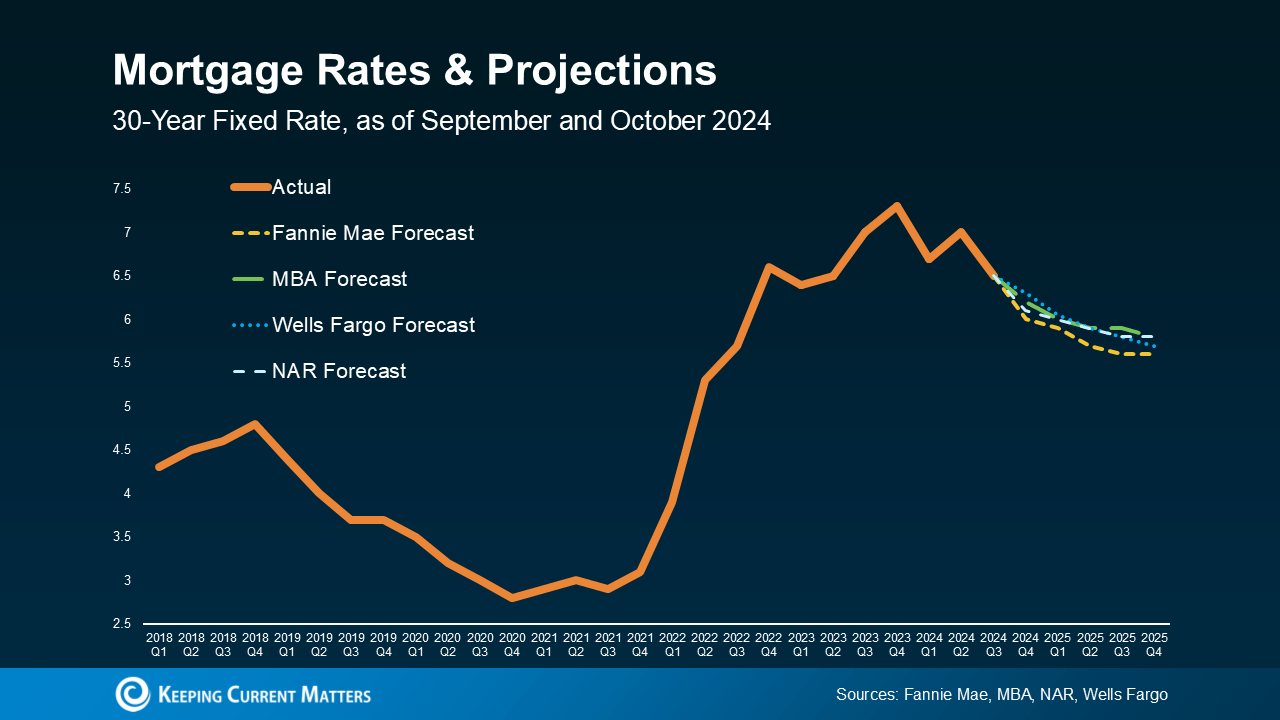
One of the biggest factors likely affecting your plans is mortgage rates, and the forecast looks positive. After rising dramatically in recent years, experts project rates will ease slightly throughout the course of 2025 (see graph below):

a graph showing the rate of a forecastWhile that decline won’t be a straight line down, the overall trend should continue over the next year. Expect a few bumps along the way, because the trajectory of rates will depend on new economic data and inflation numbers as they’re released. But don’t get too hung up on those blips and reactions from the market as they happen. Focus on the bigger picture.

Lower mortgage rates mean improving affordability. As rates come down, your monthly mortgage payment decreases, giving you more flexibility in what you can afford if you buy a home.

This shift will likely bring more buyers and sellers back into the market, though. As Charlie Dougherty, Director and Senior Economist at Wells Fargo, explains:

“Lower financing costs will likely boost demand by pulling affordability-crunched buyers off of the sidelines.”

As that happens, both inventory and competition among buyers will ramp back up. The takeaway? You can get ahead of that competition now. Lean on your agent to make sure you understand how the shifts in rates are impacting demand in your area.

Home Price Projections Show Modest Growth

While mortgage rates are expected to come down slightly, home prices are forecast to rise—but at a much more moderate pace than the market has seen in recent years.

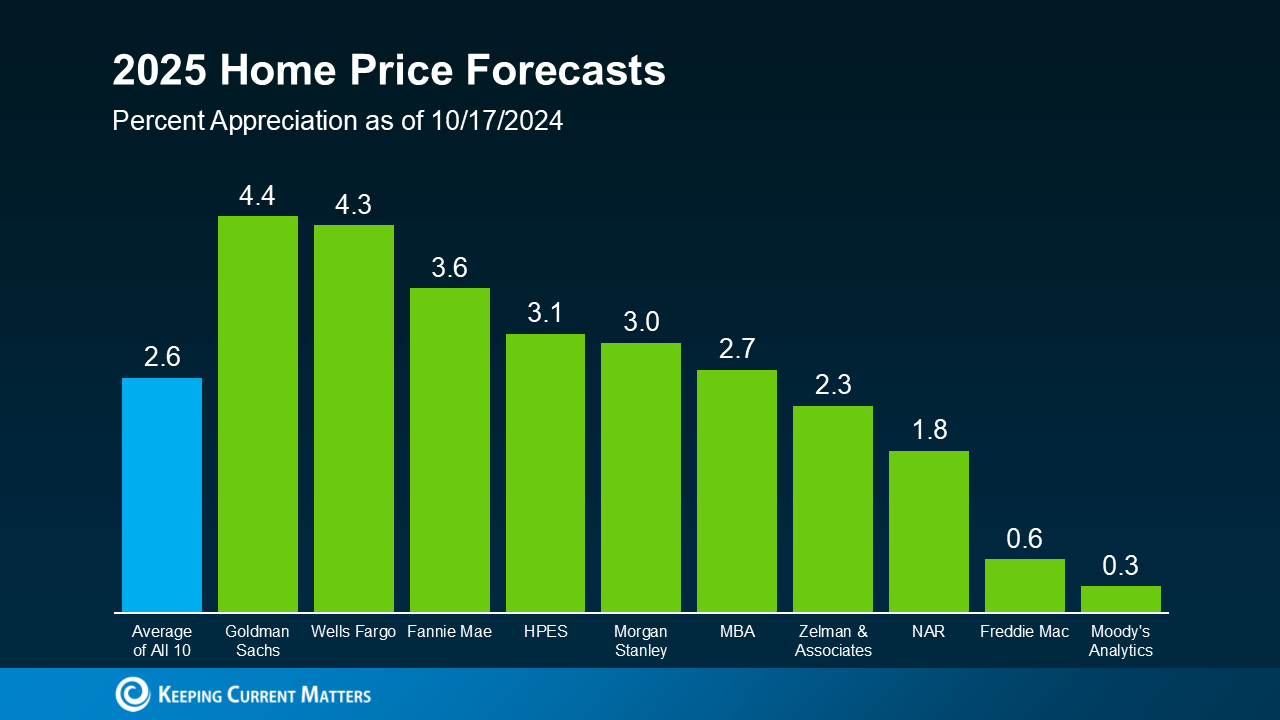
Experts are saying home prices will grow by an average of about 2.5% nationally in 2025 (see graph below):

a graph of green barsThis is far more manageable than the rapid price increases of previous years, which saw double-digit percentage growth in some markets.

What’s behind this ongoing increase in prices? Again, it has to do with demand. As more buyers return to the market, demand will rise – but so will supply as sellers feel less rate-locked.

More buyers in markets with inventory that’s still below the norm will put upward pressure on prices. But with more homes likely to be listed, supply will help keep price growth in check. This means that while prices will rise, they’ll do so at a healthier, more sustainable pace.

Of course, these national trends may not reflect exactly what’s happening in your local market. Some areas might see faster price growth, while others could see slower gains. As Lance Lambert, Co-Founder of ResiClub, says:

“Even if the average national home price forecast for 2025 is correct, it’s possible that some regional housing markets could see mild home price declines, while some markets could still see elevated appreciation. That has been, after all, the case this year.”

Even the few markets that may see flat or slightly lower prices in 2025 have had so much appreciation in recent years – it may not have a big impact. That’s why it’s important to work with a local real estate expert who can give you a clear picture of what’s happening where you’re looking to buy or sell.

Bottom Line

With mortgage rates expected to ease and home prices projected to rise at a more moderate pace, 2025 is shaping up to be a more promising year for both buyers and sellers.

If you have any questions about how these trends might impact your plans, connect with a local agent. That way you’ve got someone to help you navigate the market and make the most of the opportunities ahead.

Posted in General Articles
Oct. 14, 2024

Thinking About Buying a Condo? Here’s Why It Could Be Perfect for First-Time Buyers!

If the rising prices of single-family homes have you hesitating about homeownership, exploring condos or townhomes might just be your answer. These types of properties often come with a lower price tag, allowing you to start building equity sooner without breaking the bank. According to Realtor.com, condos are often more affordable than single-family homes, and the National Association of Home Builders notes that the construction of townhomes is at an all-time high, providing even more options for first-time buyers.


The Benefits of Condo Living

Beyond the price, condos offer several perks that make them an attractive option for first-time buyers:


Equity Building: Each mortgage payment helps build your net worth as the condo’s value rises over time.

Low Maintenance: Condos often come with HOA fees that cover exterior upkeep, snow removal, and lawn care. That means you can enjoy homeownership without the hassle of regular outdoor maintenance.

Amenities: Many condos include access to facilities like pools, fitness centers, or dog parks—all without the responsibility of managing them.

Community Feel: Condo living often means a closer-knit community with neighbors nearby, plus organized events like barbecues to create a connected atmosphere.


Remember, your first home doesn’t have to be your forever home. Getting started with a condo or townhome allows you to start building equity, which can be a stepping stone toward your next home purchase in the future.


Bottom Line

Ready to see if a condo or townhome could be the right fit? Reach out to a local real estate agent to begin your search. It might be just the step you need toward achieving your homeownership goals.

Posted in General Articles
Oct. 9, 2024

Is the Housing Market Heading for a Crash? Here’s Why Not!

Have you been hearing talk about a possible recession and feeling concerned about a repeat of the 2008 housing market crash? You're not alone, but here's some good news: the current housing market is in a much stronger position. Unlike 2008, where high supply and soaring unemployment drove a crash, today’s market is supported by two stabilizing factors.

1. High Demand and Low Supply Demand for homes today significantly outpaces supply, creating a balanced market. In 2008, there was a 13-month housing supply, which was a primary cause of the crash. Today, there’s only about a 4.2-month supply—well below the six-month benchmark of a balanced market. This high demand and limited supply keep home prices stable or rising, making a crash unlikely. As Lawrence Yun, Chief Economist at the National Association of Realtors (NAR), explains, “We simply don’t have enough inventory.”

2. Low Unemployment Low unemployment also helps prevent another housing crisis. In 2008, unemployment was over 8%, leading to foreclosures and plummeting home prices. Currently, unemployment is much lower, around 4.1%, which means more people are able to make mortgage payments and even consider buying homes, contributing to the steady demand. Rick Sharga, CEO at CJ Patrick Company, points out that today’s market dynamics are vastly different from those that led to the housing crisis.

Bottom Line There’s no need to fear a housing market crash. With demand still high and unemployment low, today’s market is stronger than it was in 2008. But since real estate is always local, it’s wise to stay informed about your area. Connect with a real estate professional to understand how these factors may affect you locally.

Posted in General Articles
Oct. 7, 2024

Why Now is the Perfect Time to Upgrade Your Home

If you’re ready to upgrade to a larger or nicer home, you’re not alone. A recent survey from Inman revealed that one of the top motivations for homebuyers is the desire for more space or better features. However, with market challenges and concerns about affordability, many people have been hesitant to make the move. Here’s the good news: today’s market conditions may actually make it easier than you think to achieve the home upgrade you’re dreaming of.

1. You Likely Have Significant Equity to Leverage

One of the biggest advantages for current homeowners is the high equity many have accumulated in their homes. Over the past few years, home prices have grown steadily, translating to significant equity gains for homeowners.

Selma Hepp, Chief Economist at CoreLogic, explains it best:

“Persistent home price growth has continued to fuel home equity gains for existing homeowners who now average about $315,000 in equity and almost $129,000 more than at the onset of the pandemic.”

This means if you’ve been in your home for several years, you’ve likely built up a solid amount of equity that could make upgrading more affordable. Leveraging this equity toward a down payment can help lower the amount you need to borrow for your new home, keeping your future monthly costs more manageable. To find out exactly how much equity you’ve built, consider reaching out to a real estate agent for a professional assessment.

2. Mortgage Rates Are Trending Downward

The second reason now may be an ideal time to upgrade is that mortgage rates have been trending down, giving buyers more purchasing power. Lower rates reduce the interest portion of monthly payments, allowing you to afford more house for the same budget.

Nadia Evangelou, Senior Economist at the National Association of Realtors (NAR), explains:

“When mortgage rates fall, the interest portion of monthly payments decreases, which lowers the total payment. This makes it easier for more borrowers to . . . qualify for mortgages that may have been unaffordable at higher rates.”

In other words, lower rates not only make it easier to qualify for financing but also increase the home price range you can comfortably afford.

What Does This Mean for You?

The combination of high home equity and lower mortgage rates means you may have a unique opportunity to secure a bigger or nicer home without a significant increase in monthly costs. Moving now could allow you to capitalize on these advantages, making it easier to achieve the upgrade you’ve been thinking about.

How to Maximize This Market Advantage

Selling and buying simultaneously can be challenging, so it’s essential to work with a knowledgeable real estate agent who can guide you through the process. From accurately assessing your home’s equity to connecting you with a trusted lender, they’ll ensure you make the most of today’s market conditions.

Bottom Line

If you’ve been on the fence about upgrading your home, now may be the perfect time to take action. With high home equity and the benefit of lower mortgage rates, you’re in a prime position to move up.

Don’t wait too long, though—reach out to a trusted real estate professional today to explore your options, assess your equity, and start planning your next move!

Posted in General Articles